
Admindroid vs ManageEngine: In the contemporary compound IT landscape, the most important component of your IT to choose is the best monitoring and reporting infrastructure for your organization. This blog is a comparison of two main competitors, Admindroid and ManageEngine, on features, flexibility, scalability, and the cost of ownership in general. By the end of this blog, you will be in a good position to determine the relative merits of each solution and also know how your business can determine what platform to adopt.
What are Admindroid and ManageEngine?
Admindroid
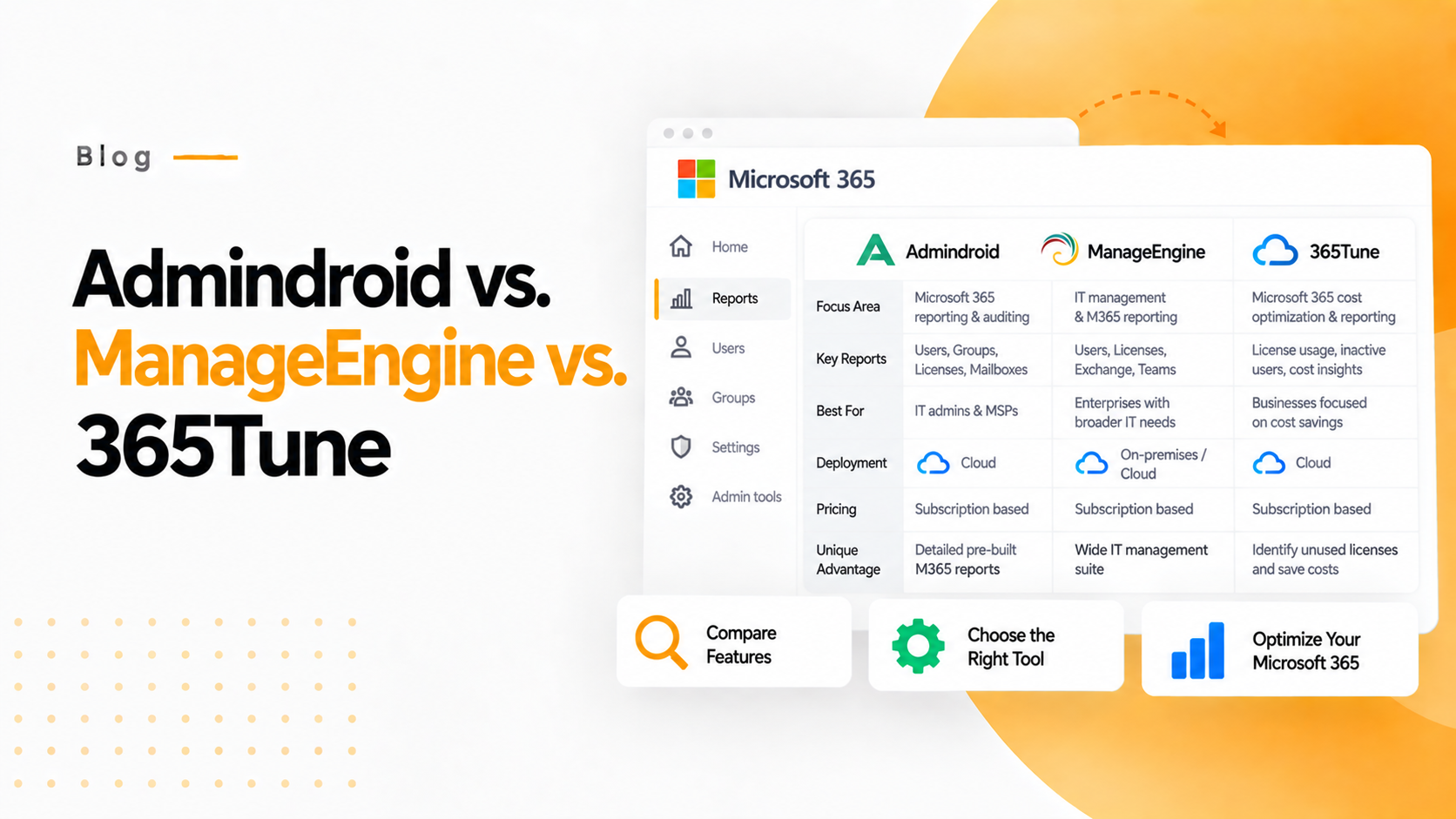
Admindroid is primarily a specialized reporting and analytics tool for Microsoft 365. Its Google Workspace support is limited and often secondary. Its main advantage is that it presents very thorough dashboards, reports, and insights, which are focused on Microsoft 365, among other things, user activity, licensing, security events, and usage trends. It is very effective for companies that have adopted cloud-based SaaS productivity suites as their first choice.
ManageEngine
ManageEngine is the IT operations branch of Zoho Corporation and comes with a wide array of more than 60 IT management tools. It is not one software but an assortment of integrated ones like Network Monitoring (OpManager), Unified Endpoint Management (Endpoint Central), and Service Management (ServiceDesk Plus). The solution is customized for the demanding and vast-scale IT resources of big organizations, which include the on-premises, hybri,d and cloud environments.
365 Tune
365 Tune is a comprehensive Microsoft 365 reporting solution designed to help organizations unlock the full value of their cloud investment. By providing actionable insights, automated analytics, and powerful cost optimization tools, 365 Tune enables IT leaders and finance teams to make data-driven decisions and ensure maximum ROI. Administrators benefit from streamlined operations and enhanced visibility into usage, security, and compliance, all protected by enterprise-grade encryption. With real-time analytics and flexible reporting, 365 Tune empowers teams to confidently manage, monitor, and optimize their Microsoft 365 environment for success.
Characteristics Comparison: Reporting and Monitoring for Admindroid vs. ManageEngine
Cloud-Storage SaaS Monitoring (Strength of Admindroid)
The Admindroid enjoys strength when the majority of your infrastructure has been deployed to either Microsoft 365 or the Google Workspace:
- Real-time tracking of seats taken and those not taken, license usage, and adoption trends.
- Talk of danger (e.g., file sharing, network globalization).
- Pre-built reports that pertain to compliance and governance, such as “top shared documents” or inactive accounts.
These qualities make Admindroid an organization of choice when it comes to organizations migrating to cloud productivity suites and requiring access to information about user behavior.
Full-Stack Infrastructure Monitoring (Strength of ManageEngine)
Conversely, when you have on-premises servers, a network device, virtual machines, databases, and SaaS on your infrastructure, ManageEngine provides you with a more comprehensive toolkit. Key capabilities include:
- SNMP performance monitoring of the network, flow data, WAN links, and device health.
- Server and application monitoring of CPU, memory, processes, and services, and custom metrics.
- Service-desk and ITSM modules connecting workflows of operational monitoring with ticketing.
- Custom dashboards reporting on the IT stack, with technical insight as well as business-facing metrics.
In organizations that deal with heterogeneous environments, namely with disparate cloud and on-premises environments, ManageEngine delivers full-fledged end-to-end monitoring functions.
Flexibility and Deployment Considerations: Which Solution is More Adaptable?
Admindroid: Lightweight Cloud-First Deployment
Since Admindroid is oriented on SaaS productivity platforms, the deployment is often lighter and faster: there is minimal authorization API authorization for Microsoft 365 or Google Workspace, and setting up dashboards. This gives it a good fit in organizations that desire quick sight of adoption and usage without the burden of infrastructural overhead.
ManageEngine: Complete, Full-Fledged Deployment
ManageEngine is very wide and might need some extra planning: network configuration, agents or SNMP setups, database configuration, help-desk integration, and training across modules. The first implementation can be more time-consuming and can involve cross-team coordination. But when installed, it provides deep visibility across IT operations.
Scalability and Growth Potential
Assuming that your organization is solely cloud-based and that adoption, usage, and security of productivity tools are your main issues, then Admindroid can scale easily in the said niche.
When your business is becoming more complex, such as with the addition of IoT, edge devices, multiple data centers, hybrid clouds, etc., then the architecture of ManageEngine has greater growth potential and scalability.
Cost, Licensing, and Total Cost of Ownership
Admindroid’s Cost Profile
The pricing of Admindroid is generally pegged to the quantity of licenses or users in the productivity suites under surveillance. The ongoing administration and maintenance costs are also relatively low since the deployment is lighter. This is likely to become a good value to organizations that are mainly interested in user adoption and SaaS governance.
ManageEngine’s Cost Profile
ManageEngine adopts a modular licensing strategy (network, servers, applications, help desk). The features are wide-ranging, and as such, the cost may increase based on the number of modules deployed or the number of monitored nodes. Also, configuration, training, and maintenance might increase the total cost of ownership. With that said, in organizations where needs are complex, the investment usually pays off through improved operational visibility and incident avoidance.
Selecting According to Budget and Use Case
In case of a limited budget and your interest is SaaS-productivity monitoring alone, then the lighter and less expensive option is likely to be Admindroid.
Should you have a budget and your application requires complete management of IT operations, then ManageEngine can provide rich returns at a higher initial and maintenance cost.
Real-Life Application and Best-Suited Platform
Use Case: Quick Implementation of Cloud Productivity Solutions
An organization that is migrating to Microsoft 365 or Google Workspace desires quick access to adoption, license utilization, and security posture. In this case, Admindroid is just the right tool: it is possible to spin up dashboards in a matter of days, keep track of usage patterns, and change licensing accordingly.
Application: Hybrid On-Premises and Cloud Infrastructure
A business has virtual machines, on-premises and cloud databases, and scans network devices, and they also have an internal help desk. They require real-time notifications, a service-level dashboard, and incident-performance connections. In the given case, ManageEngine would be the better solution, as it takes all the layers into account.
Application: Cost Control and Governance in Chunky Licensing Environments
In case the primary interest is in monitoring SaaS license waste, external sharing, and security anomalies, Admindroid is the best choice due to its simplicity and targeted delivery. In the case of the problem of avoiding downtime, tracing incidents by root causes, and high availability, the capabilities of ManageEngine shine.
Final Verdict: Choosing Between Admindroid vs. ManageEngine vs 365Tune
Admindroid would be the most suitable option in case the main worry of your organization is cloud-SaaS productivity suites (Microsoft 365, Google Workspace) and you require speedy adoption insights, user behavior, and license optimization.
When you are dealing with a heterogeneous infrastructure with a variety of network devices, servers, and applications, and you would like to have the entire picture of the IT operations (help desk, ITSM), then you will have the breadth and depth that you desire with ManageEngine.
It is also important to mention that the deployment effort, training, maintenance, and ongoing governance are very different in the two. The correct decision is not just which tool to use based on its functionality, but also your organizational preparedness, budget, and the level of visibility you require in your IT environment.
Why 365TUNE Is a Better Choice Over Admindroid and ManageEngine
Although a standard Admindroid vs. ManageEngine vs 365TUNE comparison shows that both Admindroid and ManageEngine are strong in their respective fields, neither provides a complete synergy between IT performance, financial transparency, and Microsoft 365 optimization. This is where the standard of enterprise reporting gets redefined.
When evaluating Admindroid vs. ManageEngine vs 365TUNE, it becomes clear that 365TUNE is purposefully designed to support modern Microsoft 365 environments. It empowers both IT and finance teams with a single, smart dashboard that integrates operational visibility, cost control, and compliance management. Ultimately, choosing 365TUNE over legacy reporting tools ensures you are not just monitoring your environment, but actively improving its financial and technical health.
Key benefits of 365TUNE compared to Admindroid and ManageEngine:
| Feature | Admindroid | ManageEngine | 365TUNE |
| Microsoft 365 Focus | Strong | Limited | Complete |
| Financial Reporting | Basic | Add-on Modules | Automated & Integrated |
| License Optimization | Partial | Manual | AI-Driven Insights |
| Compliance Auditing | Moderate | Good | Advanced & Real-Time |
| Deployment Speed | Fast | Slower | Instant Setup |
| IT-Finance Collaboration | Absent | Limited | Built-In |
| Cost Control Tools | Limited | Complex | Streamlined Dashboards |
Although Admindroid and ManageEngine are still worthy options in their fields, 365TUNE stands out as the most intelligent single-source solution to Microsoft 365 connections. It provides the enterprises with the power to save time, reduce cost, and make data-driven decisions with confidence by consolidating IT visibility, financial accuracy, and compliance assurance under one pane of glass.
FAQs
1. Does it allow me to use both platforms simultaneously?
Yes—organizations often combine the SaaS monitoring of Admindroid with the infrastructure breadth of ManageEngine. However, in an Admindroid vs. ManageEngine vs 365TUNE setup, 365TUNE is specifically used to bridge the gap between reporting and active remediation.
2. What is the time required to roll out each platform?
Simple SaaS monitoring can be accomplished in a few days through Admindroid deployment. ManageEngine can take weeks or months, depending on the scope (network, servers, help desk) and environment complexity.
3. What is the better platform in terms of return on investment (ROI)?
ROI depends entirely on your specific case. In case you require to go on with the SaaS licenses and user adoption, Admindroid can deliver faster ROI. Meanwhile, ManageEngine can yield high long-term ROI if the total infrastructure monitoring and incident reduction are the goals. For instance, numerous ManageEngine users claim much faster incident resolution, which consequently benefits IT productivity and offers financial savings in the long run.
4. What do I consider when deciding between self-managed deployment and outsourcing?
Assuming your team has bandwidth and experience in monitoring tools, you can implement them in-house. When you are more interested in business operations and you would prefer to delegate the setup, configuration, and use, find a partner that provides an end-to-end managed service that optimizes the platform being used, maintains it, and effectively uses it.